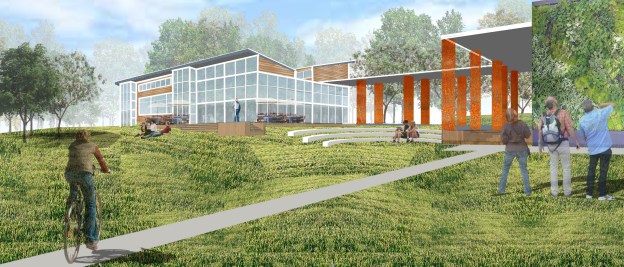
1. What are your most fundamental creative and professional influences?
The designs and writings of Tadao Ando have taught me that architecture and landscape should always have meaning and logic underlying their form. The idea that design should be meaningful and intelligent is not just an edict to me, it is an inspiration. So often, our built environment seems to be the result of expediency, budget and chance; such an environment is culturally and functionally hollow. Our shelter and daily movements could offer us comfort, joy, and human connection rather than just simple utility. Ando has shown that the regeneration of nature in the face of trauma can give people hope; that inviting nature into our daily lives through movements between the inside and outside can strengthen our connection to the rhythms of time and place; and that functional beauty can revitalize culture and community. In the frantic pace to learn the tools of landscape architecture, Ando’s example motivates me to continue and spurs my ambition.
Other creative and intellectual influences to me include Maya Lin, Frederick Law Olmsted, Laurie Olin, James Corner, Henri Matisse, Dolores Hayden, Kenneth T. Jackson, and my undergraduate history thesis advisor, Paul Jefferson. Visiting Maya Lin’s wave field at the Storm King Art Center is an experience I will never forget for its celebration of the landscape. The rhythms of the waves framed by the mountains in the distance brought me down to earth in the most basic sense. Laurie Olin’s design for the Barnes Foundation in Philadelphia demonstrates a timeless elegance worthy of the treasures housed within the museum. James Corner’s Race Street Pier reimagined an abandoned industrial pier as a community gem–a place for pause, gathering and delight. Is there any landscape architecture student whose is not inspired by Olmsted? His circuitous path to landscape architecture seemed to enable him to see the big picture and to appreciate the human experience. His designs are a gift to society, offering everyday people, generation after generation, a place for relaxation, exercise, play and community. Henri Matisse’s unparalleled use of color solidifies his place in the pantheon of creative geniuses; he was able to distill color and form to maximize their emotive power. There is such joy and energy in his art that I return to it again and again. And finally, Dolores Hayden’s and Kenneth T. Jackson’s insights into the social origins and implications of our built environment are vital to my understanding of the how, why, and so what of architecture, landscape and planning. More recently, the writer Ta-Nehisi Coates wrote a Pulitzer-worthy essay on the case for reparations to black Americans. In it, he cited Jackson’s seminal Crabgrass Frontier, which details the exclusion of black Americans from wealth accumulation through property ownership. We are living with this legacy of profound injustice, and I strive to be aware at a minimum; ultimately, I would like, if I ever develop the expertise, to use design to help repair our society.
2. Where would you like to work? What kind of sites, aside from those the market offers, would you like to explore?
My dream job is working for James Corner Field Operations, mainly because their projects seem to combine creativity and design with environmental remediation and urban revitalization. Corner’s writings on Landscape Urbanism make the compelling case for the relevance of landscape in urban revitalization and climate-change readiness. Landscape’s malleability, pervasiveness, and connectivity enable it to serve as the medium by which metro-areas can organize their systems. Moreover, Fresh Kills is probably the most exciting design (that I know of) happening now.
I would like to work on urban sites that address issues of remediation, reclamation, accessibility, adaptability, and resiliency. While these sites are the most interesting to me, I remain open to other possibilities. I still have so much to learn.
3. What are the key formal and material issues to you?
In my opinion, simplicity is elegance. I strive to reduce a design to its necessary components, while sticking to a clear and simple concept. I am also interested in the connections and transitions between the indoor and outdoor and between the public and the private. How does our transition between these zones impact our mood, identity, and activities? I believe that a more pedestrian-scaled outdoor environment (rather than car-centric) would enhance people’s moods and sense of community and promote healthful activities. Sustainable materials is also a key issue in design; with the arrival the SITES, landscape architecture now has a rubric with which to evaluate itself.
4. Where is the next frontier for urban design? Does any aspect of how you see urban design now, need to change for us to enter that frontier?
I think the next frontier is community-led design. It is neighborhood associations, non-profits, and local government recruiting landscape architects to help deliver a design that is born out of the residents’ needs and vision. This is a not new idea–the vision for High Line, for example, started with local residents–however, it needs to be more common. We cannot leave design up to developers—we should take ownership of our communities and build pride and culture by imbuing our neighborhoods with beauty, meaning and content. Landscape architects will always need to earn a living, just like developers. What we can change, though, I think is more advocacy for design that serves existing neighborhoods.
5. Do you have a personal agenda you want to pursue? If so, explain.
This is the hardest question for me to answer. I’m in late twenties, and it is only after I started working post college graduation that I developed ambition. I have always loved learning; as a teen, I envisioned myself as a sort of threadbare library junkie. Instead, I’ve discovered that I am hungry to accomplish something and work with people on a daily basis. I want to learn from people, connect people, speak my mind, discover and create.
I’m aiming for the best design job that I can get. I hope to work with people that inspire me. And if I don’t succeed, I am comforted with the belief that mediocrity is not a tragedy. I will find some small way to contribute.



 Liz Sacks